An employee walking along a thermal pipe at the Kamojang geothermal
power plant near Garut, West Java, on March 18. State utility provider
 Perusahaan Listrik Negara is targeting an additional 135 megawatts of
electricity from three new geothermal plants. (Reuters Photo/Beawiharta)
 

"Update on Current Events" – Jul 23, 2011 (Kryon channelled by Lee Carroll) - (Subjects: God, Gaia, Shift of Human Consciousness, 2012, Benevolent Design, Financial Institutes (Recession, System to Change ...), Water Cycle (Heat up, Mini Ice Ace, Oceans, Fish, Earthquakes ..), Nuclear Power Revealed, Geothermal Power, Hydro Power, Drinking Water from Seawater, No need for Oil as Much, Middle East in Peace, Persia/Iran Uprising, Muhammad, Israel, DNA, Two Dictators to fall soon, Africa, China, (Old) Souls, Species to go, Whales to Humans, Global Unity,.. etc.)
"A Summary" – Apr 2, 2011 (Kryon channeled by Lee Carroll) (Subjects: Religion, Shift of Human Consciousness, 2012, Intelligent/Benevolent Design, EU, South America, 5 Currencies, Water Cycle (Heat up, Mini Ice Ace, Oceans, Fish, Earthquakes ..), Middle East, Internet, Israel, Dictators, Palestine, US, Japan (Quake/Tsunami Disasters , People, Society ...), Nuclear Power Revealed, Hydro Power, Geothermal Power, Moon, Financial Institutes (Recession, Realign integrity values ..) , China, North Korea, Global Unity,..... etc.) - (Text version)

“.. Nuclear Power Revealed

So let me tell you what else they did. They just showed you what's wrong with nuclear power. "Safe to the maximum," they said. "Our devices are strong and cannot fail." But they did. They are no match for Gaia.

It seems that for more than 20 years, every single time we sit in the chair and speak of electric power, we tell you that hundreds of thousands of tons of push/pull energy on a regular schedule is available to you. It is moon-driven, forever. It can make all of the electricity for all of the cities on your planet, no matter how much you use. There's no environmental impact at all. Use the power of the tides, the oceans, the waves in clever ways. Use them in a bigger way than any designer has ever put together yet, to power your cities. The largest cities on your planet are on the coasts, and that's where the power source is. Hydro is the answer. It's not dangerous. You've ignored it because it seems harder to engineer and it's not in a controlled environment. Yet, you've chosen to build one of the most complex and dangerous steam engines on Earth - nuclear power.

We also have indicated that all you have to do is dig down deep enough and the planet will give you heat. It's right below the surface, not too far away all the time. You'll have a Gaia steam engine that way, too. There's no danger at all and you don't have to dig that far. All you have to do is heat fluid, and there are some fluids that boil far faster than water. So we say it again and again. Maybe this will show you what's wrong with what you've been doing, and this will turn the attitudes of your science to create something so beautiful and so powerful for your grandchildren. Why do you think you were given the moon? Now you know.

This benevolent Universe gave you an astral body that allows the waters in your ocean to push and pull and push on the most regular schedule of anything you know of. Yet there you sit enjoying just looking at it instead of using it. It could be enormous, free energy forever, ready to be converted when you design the methods of capturing it. It's time. …”
Showing posts with label UN. Show all posts

Sunday, November 3, 2019

Asia must quit 'coal addiction': UN chief

Yahoo – AFP, Joe Freeman, November 2, 2019

Several Asian megacities are at risk of flooding linked to global
warming (AFP Photo/Manan VATSYAYANA)

The UN chief on Saturday warned Asia to quit its "addiction" to coal, as climate change threatens hundreds of millions of people vulnerable to rising sea levels across the region.

The warning follows fresh research this week predicting that several Asian megacities, including Bangkok, Ho Chi Minh City and Mumbai, are at risk of extreme flooding linked to global warming.

Antonio Guterres said Asian countries need to cut reliance on coal to tackle the climate crisis, which he called the "defining issue of our time".

"There is an addiction to coal that we need to overcome because it remains a major threat in relation to climate change," he told reporters ahead of a meeting of the Association of Southeast Asian Nations (ASEAN) in Bangkok on Saturday.

He said countries in the region need to be on "the front line" of the fight by introducing carbon pricing and reforming energy policies.

"We are lagging behind," he said, adding that the rollback of coal could help curb rising global temperatures.

Coal remains a major source of power across Southeast Asia, where breakneck economic development has spurred soaring energy demands -- but at a cost to the environment.

Antonio Guterres said Asian countries need to cut reliance on coal to
head off the climate crisis (AFP Photo/Joe Freeman)

About one-third of Vietnam's energy comes from coal power with a slew of new plants set to come online by 2050, while Thailand is investing in fossil fuels.

Coastal areas across Southeast Asia have already seen major floods and seawater incursion linked to climate change.

New research this week showed that at least 300 million people worldwide are living in places at risk of inundation by 2050, a much bleaker picture than previous data predicted.

Destructive storm surges fuelled by increasingly powerful cyclones and rising seas will hit Asia hardest, according to the study in the journal Nature Communications.

The UN chief also spoke on Myanmar's persecuted Rohingya Muslims, nearly three-quarters of a million of whom were driven into Bangladesh in 2017.

He urged Myanmar's government to "address the root causes of displacement and allowing of the return, voluntary and in safety and dignity" to Myanmar.

"Some steps have been done but they are too small. We need to do much more," he said.

Myanmar's de facto leader Aung San Suu Kyi is also in Bangkok for the summit and is likely to face pressure over her country's treatment of the Rohingya, particularly from Muslim-majority Malaysia and Indonesia.

Myanmar has rebuffed all international pressure so far while only hundreds of Rohingya have returned to Myanmar, due to fear of further repression.

Related Articles:

"Recalibration of Free Choice"– Mar 3, 2012 (Kryon Channelling by Lee Caroll) - (Subjects: (Old) SoulsMidpoint on 21-12-2012, Shift of Human Consciousness, Black & White vs. Color, 1 - Spirituality (Religions) shifting, Loose a Pope “soon”, 2 - Humans will change react to drama, 3 - Civilizations/Population on Earth, 4 - Alternate energy sources (Geothermal, Tidal (Paddle wheels), Wind), 5 – Financials Institutes/concepts will change (Integrity – Ethical) , 6 - News/Media/TV to change, 7 – Big Pharmaceutical company will collapse “soon”, (Keep people sick), (Integrity – Ethical) 8 – Wars will be over on Earth, Global Unity, … etc.) (Text version)

“… 4 - Energy (again)

The natural resources of the planet are finite and will not support the continuation of what you've been doing. We've been saying this for a decade. Watch for increased science and increased funding for alternate ways of creating electricity (finally)Watch for the very companies who have the most to lose being the ones who fund it. It is the beginning of a full realization that a change of thinking is at hand. You can take things from Gaia that are energy, instead of physical resources. We speak yet; again about geothermal, about tidal, about wind. Again, we plead with you not to over-engineer this. For one of the things that Human Beings do in a technological age is to over-engineer simple things. Look at nuclear - the most over-engineered and expensive steam engine in existence!

Your current ideas of capturing energy from tidal and wave motion don't have to be technical marvels. Think paddle wheel on a pier with waves, which will create energy in both directions [waves coming and going] tied to a generator that can power dozens of neighborhoods, not full cities. Think simple and decentralize the idea of utilities. The same goes for wind and geothermal. Think of utilities for groups of homes in a cluster. You won't have a grid failure if there is no grid. This is the way of the future, and you'll be more inclined to have it sooner than later if you do this, and it won't cost as much…

Water

We've told you that one of the greatest natural resources of the planet, which is going to shift and change and be mysterious to you, is fresh water. It's going to be the next gold, dear ones. So, we have also given you some hints and examples and again we plead: Even before the potentials of running out of it, learn how to desalinate water in real time without heat. It's there, it's doable, and some already have it in the lab. This will create inexpensive fresh water for the planet. 

There is a change of attitude that is starting to occur. Slowly you're starting to see it and the only thing getting in the way of it are those companies with the big money who currently have the old system. That's starting to change as well. For the big money always wants to invest in what it knows is coming next, but it wants to create what is coming next within the framework of what it has "on the shelf." What is on the shelf is oil, coal, dams, and non-renewable resource usage. It hasn't changed much in the last 100 years, has it? Now you will see a change of free choice. You're going to see decisions made in the boardrooms that would have curled the toes of those two generations ago. Now "the worst thing they could do" might become "the best thing they could do." That, dear ones, is a change of free choice concept. When the thinkers of tomorrow see options that were never options before, that is a shift. That was number four.”


  • Stagnation of the current US Politics: Compassioned (US) leaders will arise in the future
  • Shortage of fresh/drinking water: Invention to make salt from salt water magnetic and remove it with water desalination process in high volumes
  • Pollution on Earth: 1 - Stop killing the environment! / 2 - The rise of temperature on Earth is “temporary” and is part of the "regular" Watercycle.
  • Replacement of current fossil energy source: Use of magnetics based (small/big) engines to produces electricity / free energy
  • Plastic pollution in the oceans: Invention to remove the plastics gradually from the oceans

Monday, July 18, 2016

UNESCO lists Le Corbusier's works among World Heritage Sites

Yahoo – AFP, July 17, 2016

The Maison de la Culture built by Franco-Swiss architect Le Corbusier
(AFP Photo/Philippe Desmazes)

Paris (AFP) - UNESCO on Sunday listed Franco-Swiss architect Le Corbusier's works -- including the Indian city of Chandigarh which he planned in the 1950s-- among its World Heritage Sites.

The decision was announced as the World Heritage Committee meeting in Istanbul resumed for a day on Sunday, after being suspended a day earlier due to an abortive putsch bid in Turkey which claimed more than 260 lives.

The chosen creations of Le Corbusier show his contributions to the Modern Movement that emerged after World War I with an emphasis on functionality, bold lines and materials such as concrete, iron and glass.

They include 17 sites across seven countries -- France, Switzerland, Belgium, Germany, Argentina, Japan and India -- to show the global reach of the work of Charles-Edouard Jeanneret-Gris, better known as Le Corbusier.

From his modernist master-planning of Chandigarh in northern India to Paris, which he dreamt of levelling to make way for his own more rational city, Le Corbusier was never afraid of thinking big.

He left his greatest mark on France, where no less than 10 of the 17 projects which UNESCO classified as World Heritage Sites are located.

Among them are masterpieces such as La Cite Radieuse housing project in Marseille, the Dominican monastery of La Tourette near Lyon and La Villa Savoye near Paris.


Friday, November 20, 2015

Strong public health message on UN World Toilet Day

UN Secretary General Ban Ki-moon has been leading calls for improved sanitation on World Toilet Day. Billions still suffer from a lack of proper toilets and the accompanying, heightened risk of serious illness.

Deutsche Welle, 19 Nov 2015


The United Nations says 2.4 billion people around the world don't have access to decent sanitation and more than a billion are forced to defecate out in the open. The world's population is currently just under 7.5 billion.

The UN launched World Toilet Day (19.11.2015) with a strong public health message. Poor sanitation, it said, increases the risk of illness and malnutrition, especially for children.

The UN also said that women and girls in particular need safe, clean facilities.

Secretary General Ban Ki-moon said in a statement that one in three women around the world had no access to safe toilets. "As a result they face disease, shame and potential violence when they seek a place to defecate."

In Ghana's Northern region, it's estimated that seven out of ten people - men, women and children - have no access to toilet facilities, neither in their home nor in public spaces.

But some people who have access to public toilets prefer the bush. "Inside the toilet it is always hot, it is better to consider the forest. Also they don't keep them clean. That's the main reason why I won't use a public toilet," one man in Tamale told DW.

DW visited a public toilet in Tamale where people pay a small gratuity. It was in a filthy condition.

"Toilets can't always be cleaned. Sometimes the caretaker will have additional work somewhere else so he has no time to keep things clean," the toilet attendant said.

Ban Ki-moon:'We have a moral
imperative to end open defecation'
An estimated 18,000 Ghanaians, including 5,000 children under the age of five, die every year from ailments related to poor sanitation.

Convention and customs?

The UN Millennium Development Goals, which are supposed to be achieved this year, call for the halving of the proportion of the population without access to basic sanitation.

Ban said that by many accounts, this will be "the most-missed target."

In 2013, the UN launched a campaign to end defecation in the open by 2025. In sub-Sharan Africa, 36 percent of the population were not using toilets in 1990. Twenty-five years later that figure now stands at 25 percent.

In a World Toilet Day press release, the UN says open defecation is deeply rooted in poverty, but has also been linked to convention and customs in some countries and societies. It represents some of the only times other than worship where women from rigid family circumstances may meet one another.

Maxwell Suuk in Tamale contributed to this report.

Saturday, March 21, 2015

Time now to act on looming water crisis, UN warns

Yahoo – AFP, Richard Ingham, 20 March 2015

Residents in Bangalore wait to collect drinking water in plastic pots
for their households on March 18, 2015 (AFP Photo/Manjunath Kiran)

Paris (AFP) - Without reforms, the world will be plunged into a water crisis that could be crippling for hot, dry countries, the United Nations warned Friday.

In an annual report, the UN said abuse of water was now so great that on current trends, the world will face a 40-percent "global water deficit" by 2030 -- the gap between demand for water and replenishment of it.

"The fact is there is enough water to meet the world's needs, but not without dramatically changing the way water is used, managed and shared," it said in its annual World Water Development Report.

"Measurability, monitoring and implementation" are urgently needed to make water use sustainable, said Michel Jarraud, head of the agency UN-Water and the World Meteorological Organisation (WMO).

A boy washes himself from a roadside
 water tanker in Faridabad, a suburb of 
New Delhi, on March 18, 2015 (AFP
Photo/Money Sharma)
Surging population growth is one of the biggest drivers behind the coming crisis, the report said.

Earth's current tally of around 7.3 billion humans is growing by about 80 million per year, reaching a likely 9.1 billion by 2050.

To feed these extra mouths, agriculture, which already accounts for around 70 percent of all water withdrawals, will have to increase output by some 60 percent.

Climate change -- which will alter when, where and how much rainfall comes our way -- and urbanisation will add to the coming crunch.

The report pointed to a long list of present abuses, from contamination of water by pesticides, industrial pollution and runoff from untreated sewage, to over-exploitation, especially for irrigation.

More than half of the world's population takes its drinking supplies from groundwater, which also provides 43 percent of all water used for irrigation.

Around 20 percent of these aquifers are suffering from perilous over-extraction, the report said.

So much freshwater has been sucked from the spongy rock that subsidence, or saline intrusion into freshwater in coastal areas, are often the result.

By 2050, global demand for water is likely to rise by 55 percent, mainly in response to urban growth.

"Cities will have to go further or dig deeper to access water, or will have to depend on innovative solutions or advanced technologies to meet their water demands," the report said.

The overview, scheduled for release in New Delhi, draws together data from 31 agencies in the United Nations system and 37 partners in UN-Water.

It placed the spotlight on hot, dry and thirsty regions which are already struggling with relentless demand.

In the North China Plain, intensive irrigation has caused the water table to drop by over 40 metres (130 feet) in some places, it said.

In India, the number of so-called tube wells, pulling out groundwater, rose from less than a million in 1960 to nearly 19 million 40 years later.

"This technological revolution has played an important role in the country’s efforts to combat poverty, but the ensuing development of irrigation has, in turn, resulted in significant water stress in some regions of the country, such as Maharashtra and Rajasthan," the report said.

Empty taps and dry reservoirs

Water expert Richard Connor, the report's lead author, said the outlook was bleak indeed for some areas.

"Parts of China, India and the United States, as well as in the Middle East, have been relying on the unsustainable extraction of groundwater to meet existing water demands," he told AFP.

"In my personal opinion this is, at best, a short-sighted Plan B. As these groundwater resources become depleted, there will no Plan C, and some of these areas may indeed become uninhabitable."

A migrant labourer carries a bottle of water he filled from a water tanker 
in a camp in New Delhi on March 18, 2015 (AFP Photo/Roberto Schmidt)

Last year, the Nobel-winning Intergovernmental Panel on Climate Change (IPCC) estimated that around 80 percent of the world's population "already suffers serious threats to its water security, as measured by indicators including water availability, water demand and pollution."

"Climate change can alter the availability of water and therefore threaten water security," the IPCC said.

Fixing the problems -- and addressing the needs of the 748 million people without "improved" drinking water and the 2.5 billion without mains sewerage -- requires smart and responsive governance, the new UN report said.

In real terms, this means putting together rules and incentives to curb waste, punish pollution, encourage innovation and nurture habitats that provide havens for biodiversity and water for humans.

It also means learning to defuse potential conflicts as various groups jockey for a precious and dwindling resource.

Tough decisions will have to be made on pricing, and on rallying people together.

"Present water tariffs are commonly far too low to actually limit excessive water use by wealthy households or industry," the report observed.

But it added, "responsible use may at times be more effectively fostered through awareness-raising and appealing to the common good."


Related Articles:


"Recalibration of Free Choice"–  Mar 3, 2012 (Kryon Channelling by Lee Caroll) - (Subjects: (Old) SoulsMidpoint on 21-12-2012, Shift of Human Consciousness, Black & White vs. Color, 1 - Spirituality (Religions) shifting, Loose a Pope “soon”, 2 - Humans will change react to drama, 3 - Civilizations/Population on Earth,  4 - Alternate energy sources (Geothermal, Tidal (Paddle wheels), Wind), 5 – Financials Institutes/concepts will change (Integrity – Ethical) , 6 - News/Media/TV to change, 7 – Big Pharmaceutical company will collapse “soon”, (Keep people sick), (Integrity – Ethical)  8 – Wars will be over on Earth, Global Unity, … etc.) (Text version)

“…  4 - Energy (again)

The natural resources of the planet are finite and will not support the continuation of what you've been doing. We've been saying this for a decade. Watch for increased science and increased funding for alternate ways of creating electricity (finally). Watch for the very companies who have the most to lose being the ones who fund it. It is the beginning of a full realization that a change of thinking is at hand. You can take things from Gaia that are energy, instead of physical resources. We speak yet again about geothermal, about tidal, about wind. Again, we plead with you not to over-engineer this. For one of the things that Human Beings do in a technological age is to over-engineer simple things. Look at nuclear - the most over-engineered and expensive steam engine in existence!

Your current ideas of capturing energy from tidal and wave motion don't have to be technical marvels. Think paddle wheel on a pier with waves, which will create energy in both directions [waves coming and going] tied to a generator that can power dozens of neighborhoods, not full cities. Think simple and decentralize the idea of utilities. The same goes for wind and geothermal. Think of utilities for groups of homes in a cluster. You won't have a grid failure if there is no grid. This is the way of the future, and you'll be more inclined to have it sooner than later if you do this, and it won't cost as much.

Water

We've told you that one of the greatest natural resources of the planet, which is going to shift and change and be mysterious to you, is fresh water. It's going to be the next gold, dear ones. So, we have also given you some hints and examples and again we plead: Even before the potentials of running out of it, learn how to desalinate water in real time without heat. It's there, it's doable, and some already have it in the lab. This will create inexpensive fresh water for the planet. 

There is a change of attitude that is starting to occur. Slowly you're starting to see it and the only thing getting in the way of it are those companies with the big money who currently have the old system. That's starting to change as well. For the big money always wants to invest in what it knows is coming next, but it wants to create what is coming next within the framework of what it has "on the shelf." What is on the shelf is oil, coal, dams, and non-renewable resource usage. It hasn't changed much in the last 100 years, has it? Now you will see a change of free choice. You're going to see decisions made in the boardrooms that would have curled the toes of those two generations ago. Now "the worst thing they could do" might become "the best thing they could do." That, dear ones, is a change of free choice concept. When the thinkers of tomorrow see options that were never options before, that is a shift. That was number four. ….”


“… New ideas are things you never thought of. These ideas will be given to you so you will have answers to the most profound questions that your societies have had since you were born. Inventions will bring clean water to every Human on the planet, cheaply and everywhere. Inventions will give you power, cheaply and everywhere. These ideas will wipe out all of the reasons you now have for pollution, and when you look back on it, you'll go, "This solution was always there. Why didn't we think of that? Why didn't we do this sooner?" Because it wasn't time and you were not ready. You hadn't planted the seeds and you were still battling the old energy, deciding whether you were going to terminate yourselves before 2012. Now you didn't…. and now you didn't.

It's funny, what you ponder about, and what your sociologists consider the "great current problems of mankind", for your new ideas will simply eliminate the very concepts of the questions just as they did in the past. Do you remember? Two hundred years ago, the predictions of sociologists said that you would run out of food, since there wasn't enough land to sustain a greater population. Then you discovered crop rotation and fertilizer. Suddenly, each plot of land could produce many times what it could before. Do you remember the predictions that you would run out of wood to heat your homes? Probably not. That was before electricity. It goes on and on.

So today's puzzles are just as quaint, as you will see. (1)How do you strengthen the power grids of your great nations so that they are not vulnerable to failure or don't require massive infrastructure improvement expenditures? Because cold is coming, and you are going to need more power. (2) What can you do about pollution? (3) What about world overpopulation? Some experts will tell you that a pandemic will be the answer; nature [Gaia] will kill off about one-third of the earth's population. The best minds of the century ponder these puzzles and tell you that you are headed for real problems. You have heard these things all your life.

Let me ask you this. (1) What if you could eliminate the power grid altogether? You can and will. (2) What if pollution-creating sources simply go away, due to new ideas and invention, and the environment starts to self-correct? (3) Overpopulation? You assume that humanity will continue to have children at an exponential rate since they are stupid and can't help themselves. This, dear ones, is a consciousness and education issue, and that is going to change. Imagine a zero growth attribute of many countries - something that will be common. Did you notice that some of your children today are actually starting to ponder if they should have any children at all? What a concept! ….”

Monday, November 3, 2014

Indian children asked to blow whistle on open defecation

Yahoo – AFP, 2 Nov 2014

Indian men wash in a toilet complex run by an NGO Sulabh International at
a railway station in New Delhi on April 23, 2011 (AFP file)

Children armed with whistles will soon be patrolling villages in central India to try to shame those defecating in the open, a report said Sunday.

Madhya Pradesh state government is expected soon to launch the unusual sanitation initiative, in which schoolchildren will blow their whistles loudly when they spot someone squatting in the open instead of using a toilet.

Open defecation has long been a major health and sanitation problem in India, with Prime Minister Narendra Modi saying every household should have a toilet within four years.

But a Madhya Pradesh official said many preferred to relieve themselves in the open rather than use a toilet, requiring unusual efforts to halt the practice which spreads disease.

"It is not just enough to make 'pucca' (proper) toilets to stop the practice of open defecation in rural areas," Sanjay Dubey, a divisional commissioner for Indore region, told the Press Trust of India (PTI).

"There is also a need to launch an effective social drive in such areas to check it," Dubey said.

Children in the Indore region will be educated about the need to keep their surroundings clean, before being handed the whistles and asked to roam their neighbourhoods, he told the news agency.

"This (blowing a whistle) would make that person feel shameful and would help to check this practice."

Modi has stressed the need to clean up India, which has a reputation for poor public hygiene and rudimentary sanitation.

A recent report by the UN children's fund UNICEF estimates almost 594 million -- or nearly 50 percent of India's population -- defecate in the open.

In addition to those who choose to do so, some 300 million women and girls are forced to squat in the open at night, exposing themselves to harassment and assault.

The issue was highlighted in May when two girls, aged 12 and 14, were attacked as they went into the fields to relieve themselves. Police are investigating if they were gang-raped before being lynched.

Related Article:


Thursday, July 29, 2010

UN declares access to clean water a human right

Yahoo News, 28 July 2010

UNITED NATIONS (AFP) – The UN General Assembly on Wednesday recognized access to clean water and sanitation as a human right.


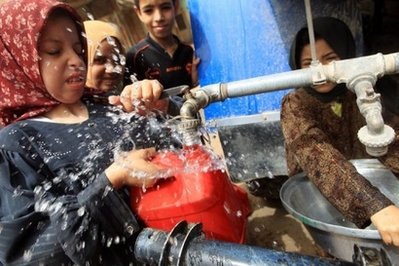
Egyptian girls fill water containers from a cistern delivering drinking water at al-Rahawe village, some 40 kilometres northeast Cairo, in May 2010. The UN General Assembly on Wednesday recognized access to clean water and sanitation as a human right. (AFP/File/Khaled Desouki)


After more than 15 years of debate on the issue, 122 countries voted in favor of a compromise Bolivian resolution enshrining the right, while 41 abstained.

The text "declares the right to safe and clean drinking water and sanitation as a human right that is essential for the full enjoyment of the right to life."

The resolution laments the fact that 884 million people lack access to safe drinking water and that more 2.6 billion do not have access to basic sanitation.

It notes that roughly two million people die every year from diseases caused by unsafe water and sanitation, most of them small children.

And it points to the pledge made by world leaders in 2000 as part of the poverty-reduction Millennium Development Goals (MDGs) to reduce by half, by 2015, the proportion of people without sustainable access to safe drinking water and sanitation.

The resolution urges states and international organizations to provide financial and technological assistance to help developing countries "scale up efforts to provide safe, clean, accessible and affordable water and sanitation for all."

Sunday, June 20, 2010

Water governance workshop in Bandung

The Jakarta Post, Sat, 06/19/2010 12:07 PM

BANDUNG: Dozens of participants are attending a five-day international workshop on water governance scheduled to be held in Bandung from Monday.

The participants, according to organizing committee member Erita K. Santosa, come from Malaysia, Vietnam, the Philippines, Thailand and Indonesia. The training program is a jointly funded initiative between UNDP Cap-Net, AguaJaring, IHE Indonesia and CKNet INA.

"Improved integrity, transparency, accountability and anti-corruption regarding water leads to better decision-making and more effective and fairer management, allocation and distribution of water resources and services." - JP

Tuesday, March 23, 2010

Ban Ki-moon: Don't wait for disaster

The Jakarta Post

Ban Ki-moon, United Nations, New York | Tue, 03/23/2010 11:48 AM | Opinion

No country can afford to ignore the lessons of the earthquakes in Chile and Haiti. We cannot stop such disasters from happening. But we can dramatically reduce their impact, if the right disaster risk reduction measures are taken in advance.

A week ago I visited Chile's earthquake zone and saw how countless lives were saved because Chile's leaders had learned the lessons of the past and heeded the warnings of crises to come.

Because stringent earthquake building codes were enforced, much worse casualties were prevented. Training and equipping first responders ahead of time meant help was there within minutes of the tremor. Embracing the spirit that governments have a responsibility for future challenges as well as current ones did more to prevent human casualties than any relief effort could.

Deaths were in the hundreds in Chile, despite the magnitude of the earthquake, at 8.8 on the Richter scale, the fifth largest since records began. In Haiti, a less intense earthquake caused hundreds of thousands of deaths. Haiti had non-existent or un-enforced building codes, and very poor preparedness.

The lessons are universally applicable. No country is immune from disaster, be it earthquakes or floods, storms or heatwaves. More and more intense natural disasters are affecting all five continents, we believe as a result of climate change. Many of the world's poorest people live in high-risk densely populated cities in flood or earthquake zones, or both.

The culture of disaster risk reduction must spread. I am encouraged that we already have a head start in this regard.

The Hyogo Framework for Action, a 10-year plan to make the world safer from disasters triggered by natural hazards, was adopted by 168 governments in 2005.

Hyogo gives national authorities a blueprint to assess and reduce risks through planning, training, and better public education. For example, making sure that schools, hospitals, and other key public infrastructure meet certain safety standards.

Based on the Hyogo Framework, the UN has made disaster risk reduction a priority. I have appointed a Special Representative for implementation of the Hyogo Framework of Action. Last year I launched the first global assessment report on disaster risk reduction in Bahrain.

There has been progress. Bangladesh lost more than 500,000 people during Cyclone Bhola in 1970. It subsequently built 2,500 cyclone shelters on elevated concrete platforms and trained more than 32,000 volunteers to help in evacuations. When Cyclone Sidr struck in 2007 with an enormous sea surge, the death toll was less than 4,000. Cyclone Nargis, a similar event in unprepared Myanmar in May 2008, cost 140,000 lives.

Cuba weathered four hurricanes in 2008. It sustained US$9 billion of physical damage but very few lives were lost.

The evidence is overwhelming. Yet the lessons of these disasters are forgotten with depressing speed. Many governments have failed to follow through on the practical measures Hyogo proposes.

Some states argue that they cannot afford to embrace the prevention model. I say no country can afford to ignore it.

We know prevention actually saves governments money in the long run. When China spent $3.15 billion on reducing the impact of floods between 1960 and 2000, it averted losses estimated at about $12 billion.

Similar savings have been recorded in Brazil, India, Vietnam and elsewhere.

Everyone has a role to play.

Governments, central and local, have to do what it takes to make communities able to cope with both continuing challenges and sudden shocks.

In flood and earthquake-prone areas, the solution is to enact and enforce building regulations. For flood prone areas, it's to move or improve squatter settlements, restore natural coastal barriers such as mangrove swamps, provide more suitable land and better infrastructure for the urban poor and install effective early warning systems.

These measures will keep many thousands of people alive who may otherwise perish. The UN is ready to help governments build preparedness at the country and regional levels.

Donor nations need to fund disaster risk reduction and preparedness measures. Adaptation to climate change in particular means investing in systems for disaster reduction, preparedness and management.

The Chile and Haiti earthquakes showed us once again why action before disasters makes all the difference. To prevent natural hazards turning into disasters, we must all act sooner and act smarter.

The writer is secretary-general of the United Nations.

Related Article:

Handbook for Reconstructing after Natural Disasters


Monday, March 22, 2010

Guest Speaker: ‘We all need to rethink the way we deal with water’

Evi Mariani, The Jakarta Post, Mon, 03/22/2010 9:34 AM

Prof. Hubert Gijzen (Photo: Ms. Siti Rachmania/UNESCO Jakarta)

Every March 22 the world commemorates World Water Day and this year the theme is “Clean Water for a Healthy World”. The world is currently facing multiple problems impacting access to clean water including climate change and rapid population growth. In recognition of World Water Day, The Jakarta Post’s Evi Mariani interviewed UNESCO Regional Director and Representative Prof. Hubert Gijzen, who formerly taught as a professor at the UNESCO-IHE Institute of Water Education, in Delft, The Netherlands. Below are some excerpts from the interview.

Question: What is the meant by World Water Day, and what should people know about water?

Answer: World Water Day has been observed since 1993, following the adoption of a resolution by the United Nations (UN) General Assembly, which designated March 22 of each year as World Water Day. This was done in recognition of the key importance of water for people, for the environment and for all life on this planet.

While generally our daily relation to water is focused on the uses and functions of water for our society and our economy, we must not forget that also nature, the environment and biodiversity are sustained by the vast freshwater resources on earth.

World Water Day is therefore meant to serve as a reminder to governments, to the private sector and to the general public of the importance to achieve access to safe and clean water for all people, and of all other important functions of water, while also managing water to ensure the long-term sustainable use of water for both people and the environment.

It also reminds us of the long way we still have to go to achieve this. Today, many of the world water resources are highly polluted, and/or becoming depleted. At the same time there are almost 1 billion people that lack access to safe water, while the number of people without access to appropriate sanitation services amounts to a daunting 2.4 billion.

This year’s theme is “Clean water for a healthy world”. What does water have to do with health?

Water is life, but on the other hand I should add that water is also a major killer. Every year several million people die from water-borne diseases, and these are mostly children under five years of age. The main culprits are pathogens, bacteria and parasites, which have been brought into the water from fecal contamination, causing diarrhea, which if not treated in a timely manner may lead to death due to dehydration.

So, indeed, there is a direct relationship between water and health, but access to safe water is not enough. It needs to be accompanied by education and awareness-raising on hygiene and health issues.

There is a growing notion among people that fresh water is getting scarcer. Is this true?

The total amount of water on earth remains basically the same. Water, however, moves in a hydrological cycle, in total about 40,000 km3 per year, and this determines when and where there will be water and in what amounts. This has been the case for many millions of years, but over more recent time spans, say in the past 50 years, the impact of people on water has become visible in two distinct ways. First, the combination of rapid population growth, urbanization, industrialization and higher standards of living has lead to more consumption in general, and of water in particular.

I estimate that world wide, less than 20 percent of all domestic and industrial wastewater receives some kind of treatment before its disposal into surface waters. This means that every day, more than 2 million tons of sewage and other effluents are dumped into the world’s waters.

The problem is much worse in developing countries where more than 90 percent of raw sewage and 70 percent of untreated industrial wastes are discharged into surface waters, and the results can be seen. Take a look at the water resources in and around Jakarta for instance. There is indeed no clean freshwater resource available anymore.

The emerging water crisis is not merely one of insufficient water quantity, but it is further aggravated by severe water quality destruction.

Second, there is the much-debated phenomenon of climate change. It is generally accepted that climate change is the main trigger behind the increase in extreme weather events, leading to a sharp increases in floods and draughts.

In developing countries, including Indonesia access to clean water is directly related to poverty. How can we ensure to make clean water accessible to all?

Indeed, water is directly related to poverty, and in that sense to the general wellbeing of people. Poor people generally pay much more for safe drinking water than the middle class living in cities and having access to municipal water supply services; this means that a disproportional share of the family income goes to the purchase of drinking water, but it also explains why poor people easily revert back to unsafe sources of water for potable use.

On top of this comes the effect of ever-increasing water quality deterioration, which jeopardizes food security and livelihoods, again with the poor being most affected. This is in fact what is meant by the term “poverty trap”. This is also why water needs specific attention when we talk about the achievement

of the Millennium Development Goals (MDGs). Water relates not only to poverty (MDG 1), but also poor water and sanitation services (MDG 7) lead to students dropping out of school (MDG 2), especially among girls (MDG 3), and it also leads to increased under-5 mortality and other major diseases (MDGs 4 and 6).

In order to address these challenges and to break the poverty trap, 24 different UN agencies joined forces to form UN Water, which brings together a wide range of expertise and capacities in all fields of water, related to food production, hygiene and health, education, the environment and many other dimensions of water.

In my view the key challenge for UN Water in cooperation with governments all over the world will be to revisit the way we have been managing our water resources. This is a challenge of developed and developing countries alike. It seems we need to rethink the way we deal with water, both in developing and developed countries.

Related Articles:

Program to change our water ways

Integrated water management ‘crucial’ to resolving snags

Prof. Hubert Gijzen - New Director UNESCO Jakarta Office