An employee walking along a thermal pipe at the Kamojang geothermal
power plant near Garut, West Java, on March 18. State utility provider
 Perusahaan Listrik Negara is targeting an additional 135 megawatts of
electricity from three new geothermal plants. (Reuters Photo/Beawiharta)
 

"Update on Current Events" – Jul 23, 2011 (Kryon channelled by Lee Carroll) - (Subjects: God, Gaia, Shift of Human Consciousness, 2012, Benevolent Design, Financial Institutes (Recession, System to Change ...), Water Cycle (Heat up, Mini Ice Ace, Oceans, Fish, Earthquakes ..), Nuclear Power Revealed, Geothermal Power, Hydro Power, Drinking Water from Seawater, No need for Oil as Much, Middle East in Peace, Persia/Iran Uprising, Muhammad, Israel, DNA, Two Dictators to fall soon, Africa, China, (Old) Souls, Species to go, Whales to Humans, Global Unity,.. etc.)
"A Summary" – Apr 2, 2011 (Kryon channeled by Lee Carroll) (Subjects: Religion, Shift of Human Consciousness, 2012, Intelligent/Benevolent Design, EU, South America, 5 Currencies, Water Cycle (Heat up, Mini Ice Ace, Oceans, Fish, Earthquakes ..), Middle East, Internet, Israel, Dictators, Palestine, US, Japan (Quake/Tsunami Disasters , People, Society ...), Nuclear Power Revealed, Hydro Power, Geothermal Power, Moon, Financial Institutes (Recession, Realign integrity values ..) , China, North Korea, Global Unity,..... etc.) - (Text version)

“.. Nuclear Power Revealed

So let me tell you what else they did. They just showed you what's wrong with nuclear power. "Safe to the maximum," they said. "Our devices are strong and cannot fail." But they did. They are no match for Gaia.

It seems that for more than 20 years, every single time we sit in the chair and speak of electric power, we tell you that hundreds of thousands of tons of push/pull energy on a regular schedule is available to you. It is moon-driven, forever. It can make all of the electricity for all of the cities on your planet, no matter how much you use. There's no environmental impact at all. Use the power of the tides, the oceans, the waves in clever ways. Use them in a bigger way than any designer has ever put together yet, to power your cities. The largest cities on your planet are on the coasts, and that's where the power source is. Hydro is the answer. It's not dangerous. You've ignored it because it seems harder to engineer and it's not in a controlled environment. Yet, you've chosen to build one of the most complex and dangerous steam engines on Earth - nuclear power.

We also have indicated that all you have to do is dig down deep enough and the planet will give you heat. It's right below the surface, not too far away all the time. You'll have a Gaia steam engine that way, too. There's no danger at all and you don't have to dig that far. All you have to do is heat fluid, and there are some fluids that boil far faster than water. So we say it again and again. Maybe this will show you what's wrong with what you've been doing, and this will turn the attitudes of your science to create something so beautiful and so powerful for your grandchildren. Why do you think you were given the moon? Now you know.

This benevolent Universe gave you an astral body that allows the waters in your ocean to push and pull and push on the most regular schedule of anything you know of. Yet there you sit enjoying just looking at it instead of using it. It could be enormous, free energy forever, ready to be converted when you design the methods of capturing it. It's time. …”
Showing posts with label Millennium Development Goals (MDG). Show all posts

Monday, December 21, 2015

From ghost city to boomtown, Phnom Penh soars high

Yahoo – AFP, Suy Se, 20 December 2015

Phnom Penh is second only to Laos in East Asia for the fastest rate of urban 
spatial expansion, according to the World Bank (AFP Photo/Tang Chhin Sothy)

From glitzy malls and high-rise flats to five-star hotels, a luxury building boom in Phnom Penh is transforming a capital once reduced to a ghost town into one of Asia's fastest growing cities.

Inside the recently opened Aeon Mall in the heart of Phnom Penh, Cambodia's first mega shopping centre, shoppers and curious residents flock to see the latest Levi's and Giordano handbags, snapping selfies in front of a giant Christmas tree.

It is a common scene across much of Southeast Asia but was previously unimaginable for many in Cambodia where around 20 percent of people still live on less than $1.25 per day.

But while poverty remains entrenched, a fast-growing middle class and elite are increasingly looking for local ways to spend their cash.

"I am glad we have such a modern mall in Phnom Penh. It shows the city is growing," says 20-year-old Bopha, a well-heeled university student who said her family made more than $1 million in a recent land sale.

Inside the recently opened Aeon Mall in the heart of Phnom Penh, Cambodia's 
first mega shopping centre, shoppers and curious residents flock to see the latest
 Levi's and Giordano handbags, snapping selfies in front of a giant Christmas tree
(AFP Photo/Tang Chhin Sothy)

Bopha said she used to have to travel to Thailand and Singapore for her shopping trips but that was now changing.

"Their cities are crowded with high-rise towers. I think we are heading in the same direction to be like them," she beamed.

The $200 million Japanese-built mall is just one of dozens of new shopping complexes, condominium projects and hotels springing up in Phnom Penh as Cambodia rides a wave of high economic growth rates in recent years.

The capital is second only to Laos in East Asia for the fastest rate of urban spatial expansion, according to the World Bank, and its economy is expected to grow at 6.9 percent this year.

Rise of the high-rise

All across the city luxury high-rise condos are popping up with names like "The Peak" and "Diamond Island", complete with billboards promising aspirational taglines such as "Sophisticated Urban Living".

A ferry sails past the five-star Sokha hotel in Phnom Penh (AFP Photo/
Tang Chhin Sothy)

According to the government, Cambodia drew construction investment worth $1.75 billion in the first nine months of 2015, a 13.7 percent rise from a year earlier.

Many of the new entrants into the kingdom's building market are developers from Japan, China, South Korea and Singapore.

The 39-storey Vattanac Capital Tower, Cambodia's first skyscraper which was finished in 2014, is designed in the shape of a dragon and incorporates Chinese traditional feng shui principles.

A few kilometres (miles) away, the local Overseas Cambodia Investment Corporation is drawing from the country's past, building Parisian-style apartments framed by a replica of the Arc de Triomphe on a riverside complex in downtown Phnom Penh.

But some are worried where the construction frenzy will leave a city once famed as the "Pearl of Asia".

In its French colonial heyday Phnom Penh was regarded as one of the loveliest cities in Southeast Asia thanks to its wide European-style avenues, carefully manicured gardens and picturesque stately homes.

Just a few decades later, the buzzing city was reduced to a ghost town when Pol Pot's brutal Khmer Rouge army seized control of the capital and ordered its two million people to evacuate.

Phnom Penh has been coming back to life since the radical communist regime
 was toppled in 1979 but the surge of activity and change to its landscape has
intensified in recent years (AFP Photo/Tang Chhin Sothy)

The city has been coming back to life since the radical communist regime was toppled in 1979 but the surge of activity and change to its landscape has intensified in recent years.

Poor pushed to city fringes

Silas Everett of The Asia Foundation in Cambodia fears the city's original charm is fast disappearing with villas and stately buildings from the colonial era being torn down to make room for lucrative new construction projects.

"Phnom Penh's architectural heritage is world renowned... Yet the rate of destruction of these buildings of significant cultural heritage is alarming," said Everett, mourning in particular the loss of buildings designed by famed Cambodian architect Vann Molyvann.

And while wealthy Cambodians are lining up for a chance to live in some of the city's most coveted new addresses, the urban poor are increasingly relegated to the edges of the capital where many were evicted to make way for commercial developments.

Critics of strongman premier Hun Sen, who has ruled with an iron fist for the last 30 years, say he has turned Cambodia into a notoriously corrupt fiefdom where those loyal to him are handsomely enriched.

But he remains unapologetic about the capital's rapid transformation.

Experts worry that Phnom Penh's original charm is disappearing with villas 
and stately buildings from the colonial era being torn down to make room for
lucrative new construction projects (AFP Photo/Tang Chhin Sothy)

Phnom Penh, he said during a speech in November, would have been a "coconut plantation" had the Khmer Rouge remained.

Instead, he added, "an already dead city survived through the bare hands of our people".

Not everyone has benefited, however.

Strolling through Aeon Mall, Seng Seat, 60, says most of the products remain outside her budget.

"The price of some clothes and shoes at the retail brand shops is too expensive," Seat said.

"I just had a look at the price and left immediately."

Friday, November 20, 2015

Strong public health message on UN World Toilet Day

UN Secretary General Ban Ki-moon has been leading calls for improved sanitation on World Toilet Day. Billions still suffer from a lack of proper toilets and the accompanying, heightened risk of serious illness.

Deutsche Welle, 19 Nov 2015


The United Nations says 2.4 billion people around the world don't have access to decent sanitation and more than a billion are forced to defecate out in the open. The world's population is currently just under 7.5 billion.

The UN launched World Toilet Day (19.11.2015) with a strong public health message. Poor sanitation, it said, increases the risk of illness and malnutrition, especially for children.

The UN also said that women and girls in particular need safe, clean facilities.

Secretary General Ban Ki-moon said in a statement that one in three women around the world had no access to safe toilets. "As a result they face disease, shame and potential violence when they seek a place to defecate."

In Ghana's Northern region, it's estimated that seven out of ten people - men, women and children - have no access to toilet facilities, neither in their home nor in public spaces.

But some people who have access to public toilets prefer the bush. "Inside the toilet it is always hot, it is better to consider the forest. Also they don't keep them clean. That's the main reason why I won't use a public toilet," one man in Tamale told DW.

DW visited a public toilet in Tamale where people pay a small gratuity. It was in a filthy condition.

"Toilets can't always be cleaned. Sometimes the caretaker will have additional work somewhere else so he has no time to keep things clean," the toilet attendant said.

Ban Ki-moon:'We have a moral
imperative to end open defecation'
An estimated 18,000 Ghanaians, including 5,000 children under the age of five, die every year from ailments related to poor sanitation.

Convention and customs?

The UN Millennium Development Goals, which are supposed to be achieved this year, call for the halving of the proportion of the population without access to basic sanitation.

Ban said that by many accounts, this will be "the most-missed target."

In 2013, the UN launched a campaign to end defecation in the open by 2025. In sub-Sharan Africa, 36 percent of the population were not using toilets in 1990. Twenty-five years later that figure now stands at 25 percent.

In a World Toilet Day press release, the UN says open defecation is deeply rooted in poverty, but has also been linked to convention and customs in some countries and societies. It represents some of the only times other than worship where women from rigid family circumstances may meet one another.

Maxwell Suuk in Tamale contributed to this report.

Wednesday, June 25, 2014

Why India needs hi-tech bio toilets to stop 620 million people defecating in the open

More than 50 percent of India's population defecates in the open - due to widespread poor sanitation. The government wants to tackle the problem by building 100,000 bio-digester toilets.

Deutsche Welle, 23 June 2014


India's sanitation statistics stink.

But in the Indian capital, a unique experiment to set up hi-tech bio-digester toilets promises to change the lives of thousands of residents who use open fields for their morning ablutions.

The World Health Organization - and figures from India's own census - suggest the number of people, who are forced to defecate in the open, is as high as 620 million.

That's more than half the population.

Small wonder, then, that during its New Delhi trial the bio-toilet has received such ecstatic praise.

Since it was installed outside a public hospital at the start of June, the bio-toilet has seen a steady stream of users.

Many residents, such as Ram Yadav, a daily wage laborer, are happy with the venture.

"We now have the privacy to use a toilet and do not have to wander into open spaces. There is also running water," says Yadav.

More than basic sanitation

But it's not just about meeting the country's basic sanitation needs and health standards. It is also about public safety.


The bio-digester toilet is about more than health and sanitation - it's about safety too

The lack of toilets in India has meant that women are often left in dangerous situations. Alone the act of having to relieve yourself at night can be dangerous - if you are a woman and have to walk out into open fields in the rural hinterlands.

"This is excellent and very helpful. There should be more of these toilets," says Gita Devi, a New Delhi homemaker.

Renowned architect Raj Rewal, better known for designing iconic exhibition pavilions and structures such as the Parliament library, has partnered in this ambitious project.

"I felt that a large number of people, particularly those living in slums, go and defecate in the open. This is a very serious problem - mainly for the 2.5 million women in the city who have no facility to go to toilets in the morning," Rewal says.

This prototype uses aluminium sandwiched honeycomb panels, with stainless steel veneering for durability. The eco-friendly toilet can be set up anywhere - even where there are no sewer lines.

High altitude innovation

A similar system has been tested successfully at high altitude by army personnel at the Siachen Glacier in Kashmir.

And India's Defense Research and Development Organisation (DRDO) plans to help roll out the bio-toilet program across the country.

"We developed a technology which includes a consortium of psychrophilic bacteria, which was brought from Antarctica, cultured in the laboratory, and which can degrade fecal matter into water, carbon dioxide and methane," says Dr William Selvamurthy, a former scientist at the DRDO. "This is a very, very innovative technology."

Selvamurthy says the bio-toilet has no geographical or climate limitations, and can be installed without the need for large sewerage networks.

If mass-produced, a single unit will cost between 400 to 700 euros

Some have undergone design modifications. For example, to avoid the toilets getting clogged at railway stations, where people might use them to dispose of non-biodegradable plastics, like bottles, a special lid has been constructed.

"The Indian railways have adopted this technology and the existing coaches are being retro-fitted. It will also go to other civilian sectors in a very horizontal spread to a very large cross-section of our society," Selvamurthy says.

Total Sanitation Mission 2020

Architect Raj Rewal hopes the toilets will be set up across the country soon.

"It can go to any city, any small town, and hopefully to small villages if we work hard on the design and economics of the toilets," says Rewal.

The Indian government is keen to fast-track the scheme. Open defecation has serious health implications and is a big economic burden on the country.

Only one state in India, Sikkim, is free of open defecation. Under its Total Sanitation Mission, the government aims to eliminate the problem of open defecation by 2022.

Monday, March 19, 2012

A New Home for Rp 70m? It Might Be Within Reach for Indonesia's Poor

Jakarta Globe, Anita Rachman, March 19, 2012

Model units of the prefab homes that the Ministry of Public Housing
 envisions as an affordable plan to homeownership. Accounting for all
the costs  associated with them, setting up the houses would cost at least
Rp 70 million, with mortgage plans available. (JG Photo/ Afriadi Hikmal)
  
       
Related articles

Shortly after he was appointed public housing minister in October, Djan Faridz was given a daunting challenge: build Rp 25 million ($2,750) houses for low-ranking civil servants on land provided by the local government.

“I was shocked,” he told the Jakarta Globe in a recent interview. “How can I build a house with only Rp 25 million? And I wanted it to have at least a 36-square-meter [floor area].”

But he soon found an answer in Palembang, South Sumatra. In a trip to the province, he met representatives of Grand Wijaya Persada, a construction company that has been building houses for even less than that amount.

A model cheap house

Inside the ministry compound in South Jakarta, a fully furnished, two-bedroom 45-square-meter model unit now stands.

The basic structure of the prefab house costs Rp 35 million, sans flooring, ceiling and paint, which runs an additional Rp 5 million.

Beside it, a model unit of the Rp 25 million, 36-square-meter version is being built. Visible for now is the steel mold where concrete would be poured into to create the basic structure. But it won’t remain like that for long, because the house can be finished in as little as seven days.

Anyone interested in looking at the model units is welcome at the ministry. Both units have a defined two-bedroom floor plan according to the prefab mold patented by Umar Sumadi, the production head at Grand Wijaya. A single mold can be used to construct as many as 200 houses.

The ministry has already signed a memorandum of understanding with several other ministries committing to help provide civil servants with these cheap houses.

Djan said the project would be done in 60 districts and municipalities across the country, starting off with East Nusa Tenggara (NTT) and North Maluku.

The ministry is aiming to build around 7,900 cheap houses in NTT and 2,000 in North Maluku this year, among others.

Rp 70 million dream

The minister, however, is keen on finding a way to make the same cheap houses available to all Indonesians.

“Housing is a serious matter, after food and clothing. But many cannot afford it because it’s remarkably expensive,” Djan said.

According to his ministry’s data, as many as 4.8 million Indonesians today live in dilapidated houses, and more than 11 million people do not have their own homes. And with real estate prices expected to keep rising, chances are these figures will only climb higher.

That’s why the minister’s goal is to give Indonesians a chance to own a home for an affordable Rp 70 million.

Here’s how he sees it: in certain parts of Jakarta’s satellite cities, say Depok, people can still get a 60-square-meter plot of land for less than Rp 20 million.

If the Rp 25 million, 36-square-meter prefab model is built on that land, then for as little as Rp 70 million — including flooring, ceiling, paint, electricity and water installations and other fixtures — an Indonesian family can have a home it can call its own.

“Of course you can also get it elsewhere, anywhere you want,” the minister said. “So if you are outside Java, you can get a house for even less than Rp 70 million.”

Bringing it to the people

The idea is that the ministry will work with developers who can build subdivisions full of these prefab units.

For a housing project to be economically feasible, at least 200 units must be constructed to maximize the use of the mold. Grand Wijaya would earn a 5 percent licensing fee for each socialized housing project.

Indonesians can then buy the houses from these developers at prices determined together with the ministry. Of course, certain conditions, such as that the potential buyer does not own a house yet, have to be met.

The ministry will then help get bank housing loans. For a Rp 70 million house, Djan said the current computation would see a buyer pay Rp 575,000 a month for 15 years.

But it might still be a while before these become a reality, as the ministry hasn’t begun discussions with developers yet.

Real Estate Indonesia chair Setyo Maharso said delivering low-cost homes was not a problem, and the ministry’s plan could be executed in the same way as previous programs.

Doing it in Jakarta, though, would not be easy, he said.

“It’s even quite difficult to build it in Depok. Bogor or Bekasi are still possible, but not here in Jakarta,” he said.

Although he completely supports the policy, he said prefab units were not always ideal.

“Low-income families usually buy a small house, but when they have money, they will build more rooms. But prefab houses are not really flexible for modifications,” he said.

Priyo Suprobo, a structural engineer with the Sepuluh November Institute of Technology (ITS), agreed. He said modifying a prefab structure would be difficult, and that the lack of flexibility was a major weakness.

Another is that people could not embed electrical wiring into the walls.

But Priyo still believes this kind of model can help low-income families solve their housing problems, “especially if the ministry provides a subsidy,” he said.

Will people buy?

Ridwan, a security guard in an office building in Kuningan, currently rents a house in Kedoya in Kebun Jeruk, West Jakarta, with his wife and child for Rp 350,000.

Hearing about the Rp 70 million house made him happy and hopeful. “I think it’s affordable, and 36 square meters looks decent enough,” he said.

On the other hand, Afrizal, a single 24-year-old noddle seller in Lenteng Agung, felt the Rp 575,000 amortization per month was still out of reach.

“It’s already hard to make ends meet,” he said.

Related Article:


Thursday, August 11, 2011

Operations Begin for New Bali Plant To Purify Sewage Into Usable Water

Jakarta Globe, Made Arya Kencana, August 11, 2011

Denpasar. Bali officially began operations at a water purification facility on Wednesday that turns treated sewage into clean, usable water.

“The Balinese people are worried about predictions that the island will suffer from a water crisis in 2015,” provincial regional secretary Made Jendra said at the plant’s opening. “This, at least, will be alleviated by the operation of this facility.”

Jendra said the treatment plant, which was a joint project of the central government, Denpasar administration, Badung district government and Japan International Cooperation Agency, would be able to produce 9,000 cubic meters of clean water every day, or more than 100 liters per second.

While that figure was far from the estimated 1,500 liters per second needed to avert a water crisis in 2015, he said clean water production would hopefully grow further with the completion of a sewage network project.

Goro Yasuda, director for overseas projects at Japan’s Ministry of Land, Infrastructure, Transportation and Tourism, said Bali would face a water crisis by 2015 because “the need for clean water vastly exceeds the capacity of the regional water company.”

Dewa Punia Asa, head of Bali’s public works office, said that so far only 8,647 households in Denpasar and Badung districts were linked to the first phase of the Denpasar Sewage Development Project. Those households are estimated to produce about 22,000 cubic meters of liquid waste a day.

A second phase, expected to be completed in 2014, is targeting 7,200 new connections, mostly hotels and restaurants in the tourist areas of Sanur, Kuta, Legian and Seminyak.

Tjok Bagus Budiana, who heads the province’s sewage management service, said the facility was designed to process as much as 51,000 cubic meters of liquid waste per day. It is built on a 17.5 hectare plot, 2.5 hectares of which is reserved for reservoirs to hold liquid waste.

He said households had to pay a monthly fee of Rp 15,000 to Rp 25,000 ($1.75 to $2.90) to be connected to the network. The fee, he added, would be higher for participating businesses.

Friday, June 24, 2011

30% of Indonesians Do Not Use Toilets: First Lady

Jakarta Globe, June 24, 2011

First Lady Ani Yudhoyono on Friday said that she was very concerned with the low levels of sanitation in Indonesia, citing a survey that states that 30 percent of Indonesian people still do not use toilets to defecate.

“Currently, 30 percent of our people are still doing BAB [defecate] in all the wrong places because of the lack of access to toilets,” Ani said in a speech in front of the participants at 2011 Santitation Jamboree in Jakarta on Friday, as quoted by news portal Detik.com.

According to the National Statistics Bureau (BPS), Indonesia population is more than 237 million,  therefore more than 71 million people in the country still do not use toilets.

She said there were regions in Indonesia who were not providing good sanitation.

“If only all regional heads were committed [in providing good sanitation], God Willing, our lives would be more prosperous,” Ani said, adding that it was difficult to find clean water and good sanitation in the suburbs.

“In the suburbs, there are many [people] who defecate in the river,” she said.

Based on the survey, she said, 50 percent of Indonesian people still do not have access to clean water.

“The rest use risky water,” Ani said.

The government is striving to sanitation conditions by focusing on three programs, she said.

The first program is for Indonesian children to use toilets to defecate. The second, more access to clean water for people and the third, to clear water from waste.

“If the river is polluted, all people are at risk of contracting diseases,” she said.

Wednesday, February 23, 2011

Australian government supports clean water program

Antara News, Wed, February 23 2011


"This will help improve their health, quality of life and economic potential."


Jakarta (ANTARA News) - The Australia government supported clean water access program for about 2,000 households in Serang, Banten.

(FOTO ANTARA/Sahrul Manda Tikupadang)
"More than 100,000 people in Serang now have easier and cheaper access to clean water. This will help improve their health, quality of life and economic potential," AusAID Infrastructure Counselor Ben Power said in a press release received here, Wednesday.

Serang is one of 35 Indonesian districts that have received grants to install new water connections. Australia is working closely with the Indonesian Government to administer this program.

"Australia is proud to be working with Indonesia to improve access to clean water and is committed to helping Indonesia reach its goal of halving the amount of people living without access to clean drinking water," said Power.

The grant is part of Australia`s 25 million Australian dollars commitment to Indonesia to increase piped water in poor urban communities, and to increase the number of households with sewerage connections.

This support will give about 60,000 households across Indonesia new connections to piped water and up to 10,000 household`s sewerage connections.

A further 400,000 Indonesians will have access to cleaner water and better sanitation as a result of the Grant Water program.

Furthermore several cities and districts in Sumatra, Java, Kalimantan, West Nusa Tenggara and Sulawesi will also received benefit from this new water and sanitation initiative.

As well as this grant program, Australia is helping local governments manage community water supply and sanitation utilities to ensure the sustainability of this development.

Editor: Priyambodo

Thursday, July 29, 2010

UN declares access to clean water a human right

Yahoo News, 28 July 2010

UNITED NATIONS (AFP) – The UN General Assembly on Wednesday recognized access to clean water and sanitation as a human right.


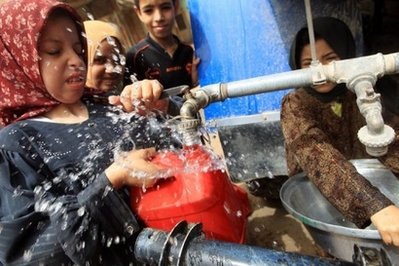
Egyptian girls fill water containers from a cistern delivering drinking water at al-Rahawe village, some 40 kilometres northeast Cairo, in May 2010. The UN General Assembly on Wednesday recognized access to clean water and sanitation as a human right. (AFP/File/Khaled Desouki)


After more than 15 years of debate on the issue, 122 countries voted in favor of a compromise Bolivian resolution enshrining the right, while 41 abstained.

The text "declares the right to safe and clean drinking water and sanitation as a human right that is essential for the full enjoyment of the right to life."

The resolution laments the fact that 884 million people lack access to safe drinking water and that more 2.6 billion do not have access to basic sanitation.

It notes that roughly two million people die every year from diseases caused by unsafe water and sanitation, most of them small children.

And it points to the pledge made by world leaders in 2000 as part of the poverty-reduction Millennium Development Goals (MDGs) to reduce by half, by 2015, the proportion of people without sustainable access to safe drinking water and sanitation.

The resolution urges states and international organizations to provide financial and technological assistance to help developing countries "scale up efforts to provide safe, clean, accessible and affordable water and sanitation for all."

Monday, June 21, 2010

OZ pledges cash for clean water access, sewerages

The Jakarta Post | Mon, 06/21/2010 10:04 AM
Australia plans to give A$25 million (US$21.7 million) to 29 local governments in Indonesia to increase access to clean water and expand household sewerage connections.

“The local governments are expected to provide a clean water supply service and good sanitation for their communities,” Public Works Minister Djoko Kirmanto said recently.

The 29 regions include Palembang in South Sumatra, Palangkaraya in Central Kalimantan, Banjarbaru in South Kalimantan, Pekalongan in Central Java, Bogor and Banjar in West Java and Malang in East Java.

Grants for sewerage connections will be provided for Banjarmasin in South Kalimantan, Surakarta in Central Java, Balikpapan in East Kalimantan, Jambi in Central Sumatra, Payakumbuh in West Sumatra, Blitar in East Java and Denpasar in Bali.

However, the funds will be made available only once the local governments have developed water pipe networks and sewerage systems.

“This disbursement is output based, and this is the first time we have ever used this kind of approach,” the minister said.

In this output-based system, recipients are required to have included clean water access and sanitation programs in their annual regional budgets.

The recipients can only get the allocated fund once they have proven that they have built pipe networks for clean water and a sewerage.

“For each of the household pipes installed, we will pay Rp 2 million [US$218],” the minister said. “And if they install more than 1,000 pipes, we will pay Rp 3 million [$328] for each additional pipe,” he added.

Australian Ambassador to Indonesia Bill Farmer said the grant was meant to improve Indonesians’ hygiene.
“The initiative will give about 480,000 Indonesians ready access to cleaner water and better sanitation, helping people to stay healthier and be more productive,” he said.

The Australian Government has provided a total of A$300 million (US$260 million) to improve clean water and sanitation programs in the Asia-Pacific region. (map)

Monday, March 22, 2010

Guest Speaker: ‘We all need to rethink the way we deal with water’

Evi Mariani, The Jakarta Post, Mon, 03/22/2010 9:34 AM

Prof. Hubert Gijzen (Photo: Ms. Siti Rachmania/UNESCO Jakarta)

Every March 22 the world commemorates World Water Day and this year the theme is “Clean Water for a Healthy World”. The world is currently facing multiple problems impacting access to clean water including climate change and rapid population growth. In recognition of World Water Day, The Jakarta Post’s Evi Mariani interviewed UNESCO Regional Director and Representative Prof. Hubert Gijzen, who formerly taught as a professor at the UNESCO-IHE Institute of Water Education, in Delft, The Netherlands. Below are some excerpts from the interview.

Question: What is the meant by World Water Day, and what should people know about water?

Answer: World Water Day has been observed since 1993, following the adoption of a resolution by the United Nations (UN) General Assembly, which designated March 22 of each year as World Water Day. This was done in recognition of the key importance of water for people, for the environment and for all life on this planet.

While generally our daily relation to water is focused on the uses and functions of water for our society and our economy, we must not forget that also nature, the environment and biodiversity are sustained by the vast freshwater resources on earth.

World Water Day is therefore meant to serve as a reminder to governments, to the private sector and to the general public of the importance to achieve access to safe and clean water for all people, and of all other important functions of water, while also managing water to ensure the long-term sustainable use of water for both people and the environment.

It also reminds us of the long way we still have to go to achieve this. Today, many of the world water resources are highly polluted, and/or becoming depleted. At the same time there are almost 1 billion people that lack access to safe water, while the number of people without access to appropriate sanitation services amounts to a daunting 2.4 billion.

This year’s theme is “Clean water for a healthy world”. What does water have to do with health?

Water is life, but on the other hand I should add that water is also a major killer. Every year several million people die from water-borne diseases, and these are mostly children under five years of age. The main culprits are pathogens, bacteria and parasites, which have been brought into the water from fecal contamination, causing diarrhea, which if not treated in a timely manner may lead to death due to dehydration.

So, indeed, there is a direct relationship between water and health, but access to safe water is not enough. It needs to be accompanied by education and awareness-raising on hygiene and health issues.

There is a growing notion among people that fresh water is getting scarcer. Is this true?

The total amount of water on earth remains basically the same. Water, however, moves in a hydrological cycle, in total about 40,000 km3 per year, and this determines when and where there will be water and in what amounts. This has been the case for many millions of years, but over more recent time spans, say in the past 50 years, the impact of people on water has become visible in two distinct ways. First, the combination of rapid population growth, urbanization, industrialization and higher standards of living has lead to more consumption in general, and of water in particular.

I estimate that world wide, less than 20 percent of all domestic and industrial wastewater receives some kind of treatment before its disposal into surface waters. This means that every day, more than 2 million tons of sewage and other effluents are dumped into the world’s waters.

The problem is much worse in developing countries where more than 90 percent of raw sewage and 70 percent of untreated industrial wastes are discharged into surface waters, and the results can be seen. Take a look at the water resources in and around Jakarta for instance. There is indeed no clean freshwater resource available anymore.

The emerging water crisis is not merely one of insufficient water quantity, but it is further aggravated by severe water quality destruction.

Second, there is the much-debated phenomenon of climate change. It is generally accepted that climate change is the main trigger behind the increase in extreme weather events, leading to a sharp increases in floods and draughts.

In developing countries, including Indonesia access to clean water is directly related to poverty. How can we ensure to make clean water accessible to all?

Indeed, water is directly related to poverty, and in that sense to the general wellbeing of people. Poor people generally pay much more for safe drinking water than the middle class living in cities and having access to municipal water supply services; this means that a disproportional share of the family income goes to the purchase of drinking water, but it also explains why poor people easily revert back to unsafe sources of water for potable use.

On top of this comes the effect of ever-increasing water quality deterioration, which jeopardizes food security and livelihoods, again with the poor being most affected. This is in fact what is meant by the term “poverty trap”. This is also why water needs specific attention when we talk about the achievement

of the Millennium Development Goals (MDGs). Water relates not only to poverty (MDG 1), but also poor water and sanitation services (MDG 7) lead to students dropping out of school (MDG 2), especially among girls (MDG 3), and it also leads to increased under-5 mortality and other major diseases (MDGs 4 and 6).

In order to address these challenges and to break the poverty trap, 24 different UN agencies joined forces to form UN Water, which brings together a wide range of expertise and capacities in all fields of water, related to food production, hygiene and health, education, the environment and many other dimensions of water.

In my view the key challenge for UN Water in cooperation with governments all over the world will be to revisit the way we have been managing our water resources. This is a challenge of developed and developing countries alike. It seems we need to rethink the way we deal with water, both in developing and developed countries.

Related Articles:

Program to change our water ways

Integrated water management ‘crucial’ to resolving snags

Prof. Hubert Gijzen - New Director UNESCO Jakarta Office


Wednesday, February 17, 2010

917m Asians Now Live in Extreme Poverty: Report

Jakarta Globe, February 17, 2010

A woman cleaning her child in a North Jakarta slum. According to the city’s Public Works Office data, 70 percent of the country is forced to wash in contaminated water. (Photo: Afriadi Hikmal, JG)

Manila. Seventeen million Asians have fallen into extreme poverty due to the global financial crisis, the Asian Development Bank and the United Nations said on Wednesday.

And another 4 million could this year slip into the same situation due to the effects of the slump, officials from the two organizations said launching a joint report on poverty alleviation here.

This is on top of the 900 million people in Asia who are already living in extreme poverty, defined as living on less than $1.25 a day.

Asia had shown great progress in bringing people out of poverty in recent years, ADB vice president Ursula Schaefer-Preuss said. “But gains are being reversed due to the economic crisis,” she said.

UN Under-Secretary General Noeleen Heyzer said that people in the export and tourism sectors in Asia had lost and were still losing their jobs due to the crisis, which swept across the globe in late 2008.

Less foreign investment, aid and remittances from overseas workers were further hurting Asia’s poor, Heyzer said.

The report said more women, who form the majority of Asia’s low-skilled and temporary workforce, than men had been forced back into extreme poverty due to the crisis.

UN Assistant Secretary General Ajay Chhibber said the Asia-Pacific was doing quite well in areas such as infrastructure in achieving the UN’s Millennium Development Goals that are aimed at bringing people out of poverty.

“But it lags woefully behind in social issues,” he said.

Even Latin America and Eastern Europe had better “social protections” than Asia such as pensions and unemployment insurance, Chhibber said.

Only 2 percent to 3 percent of gross domestic product in Asia goes to such social protections, he said, adding that this figure should ideally be 4 percent to 6 percent.

This meant large numbers of Asians could fall back into poverty during the crisis or even during natural disasters, he said.

The report said the could protect itself from future crises though regional cooperation. “Regional cooperation would also be particularly valuable for the trade in food, and could include grain banks that are maintained in each country but readily accessible to others.”

Expanding Asian “monetary and financial coordination would be particularly useful to reduce external shocks such as with the global financial crisis.

Asian nations could consider diversifying their export markets to become less dependent on demand from the West, the joint report advised.

“By lowering trade barriers and creating more opportunity for the Asia-Pacific region to invest within itself, there can be a greater insulation against such crisis in the future.”

JG, AFP