An employee walking along a thermal pipe at the Kamojang geothermal
power plant near Garut, West Java, on March 18. State utility provider
 Perusahaan Listrik Negara is targeting an additional 135 megawatts of
electricity from three new geothermal plants. (Reuters Photo/Beawiharta)
 

"Update on Current Events" – Jul 23, 2011 (Kryon channelled by Lee Carroll) - (Subjects: God, Gaia, Shift of Human Consciousness, 2012, Benevolent Design, Financial Institutes (Recession, System to Change ...), Water Cycle (Heat up, Mini Ice Ace, Oceans, Fish, Earthquakes ..), Nuclear Power Revealed, Geothermal Power, Hydro Power, Drinking Water from Seawater, No need for Oil as Much, Middle East in Peace, Persia/Iran Uprising, Muhammad, Israel, DNA, Two Dictators to fall soon, Africa, China, (Old) Souls, Species to go, Whales to Humans, Global Unity,.. etc.)
"A Summary" – Apr 2, 2011 (Kryon channeled by Lee Carroll) (Subjects: Religion, Shift of Human Consciousness, 2012, Intelligent/Benevolent Design, EU, South America, 5 Currencies, Water Cycle (Heat up, Mini Ice Ace, Oceans, Fish, Earthquakes ..), Middle East, Internet, Israel, Dictators, Palestine, US, Japan (Quake/Tsunami Disasters , People, Society ...), Nuclear Power Revealed, Hydro Power, Geothermal Power, Moon, Financial Institutes (Recession, Realign integrity values ..) , China, North Korea, Global Unity,..... etc.) - (Text version)

“.. Nuclear Power Revealed

So let me tell you what else they did. They just showed you what's wrong with nuclear power. "Safe to the maximum," they said. "Our devices are strong and cannot fail." But they did. They are no match for Gaia.

It seems that for more than 20 years, every single time we sit in the chair and speak of electric power, we tell you that hundreds of thousands of tons of push/pull energy on a regular schedule is available to you. It is moon-driven, forever. It can make all of the electricity for all of the cities on your planet, no matter how much you use. There's no environmental impact at all. Use the power of the tides, the oceans, the waves in clever ways. Use them in a bigger way than any designer has ever put together yet, to power your cities. The largest cities on your planet are on the coasts, and that's where the power source is. Hydro is the answer. It's not dangerous. You've ignored it because it seems harder to engineer and it's not in a controlled environment. Yet, you've chosen to build one of the most complex and dangerous steam engines on Earth - nuclear power.

We also have indicated that all you have to do is dig down deep enough and the planet will give you heat. It's right below the surface, not too far away all the time. You'll have a Gaia steam engine that way, too. There's no danger at all and you don't have to dig that far. All you have to do is heat fluid, and there are some fluids that boil far faster than water. So we say it again and again. Maybe this will show you what's wrong with what you've been doing, and this will turn the attitudes of your science to create something so beautiful and so powerful for your grandchildren. Why do you think you were given the moon? Now you know.

This benevolent Universe gave you an astral body that allows the waters in your ocean to push and pull and push on the most regular schedule of anything you know of. Yet there you sit enjoying just looking at it instead of using it. It could be enormous, free energy forever, ready to be converted when you design the methods of capturing it. It's time. …”
Showing posts with label Contractors. Show all posts

Friday, July 10, 2020

Japan to limit financing of overseas coal power plants

Yahoo – AFP, Natsuko FUKUE, July 9, 2020

Protesters wearing masks of world leaders including Japanese Prime Minister
Shinzo Abe demonstrated against climate change and coal during the G20 summit in
Osaka in June 2019 (AFP Photo/Pak YIU)

Japan said Thursday it would tighten rules for investment in foreign coal-fired power stations on environmental grounds, but stopped short of ending government funding for projects.

The move comes with the world's third-largest economy under fire for financing projects to build coal plants at home and abroad -- notably in Southeast Asia.

Economy, Trade and Industry Minister Hiroshi Kajiyama told reporters the government "has decided to tighten" the rules for supporting investment.

Countries seeking investment would be required to change their "behaviour" towards decarbonisation, Kajiyama said, but added that the new policy was not about cutting back funding.

"There are developing nations in the world that can only choose coal as an energy source," he said.

Further details were not immediately available.

The government currently provides funding to Japanese companies if their projects meet certain criteria -- such as when a foreign country has no options but to choose coal due to economic reasons.

Major decision

The Global Energy Monitor watchdog said last year that Japan accounted for over US$4.8 billion in financing for coal power plants abroad -- particularly in Indonesia, Vietnam and Bangladesh.

Kimiko Hirata, international director of the environmental NGO Kiko Network, said the new investment decision was a "major decision."

"The coal-fired power stations were the pillar of infrastructure exports for Japan," she told AFP.

But Greenpeace criticised the decision as falling short, saying it showed "no clear policy".

Last week, the government promised to study ways of phasing out older, more polluting coal-fired power stations by 2030, following reports it plans to mothball around 100 ageing plants.

Japan has some 140 coal-fired power stations, providing nearly one-third of the nation's total electricity generation, and second only to LNG-fired plants.

But there are more than a dozen projects underway to build more plants -- despite efforts to phase them out in many other parts of the world.

The appetite for coal-fired plants increased significantly after the Fukushima nuclear power plant accident following the 2011 tsunami.

Japan wants nearly a quarter of its energy needs to be met by renewable sources -- including wind and solar -- by 2030, a figure critics describe as unambitious based on current levels of around 17 percent.

Friday, March 23, 2018

Building site fatalities on Dutch construction projects double in two years

DutchNews, March 22, 2018


The number of job-related deaths on building sites in the Netherlands has doubled in the past two years, according to the social affairs ministry inspectorate SZW. 

In 2017, there were 20 fatalities, up from 16 in 2016, public broadcaster NOS reported on Thursday. 


The increase is attributed to the fact that there are far more subcontractors – independent contractors known as zzp’ers in the Netherlands – working on Dutch building sites in addition to foreign workers who lack knowledge of the Dutch language and unqualified workers. 


‘Previously there was always one major contractor with a safety coordinator, but nowadays there isn’t and this has led to big problems,’ the inspectorate said. 


The building sector leads all others in terms at workplace fatalities. There were 162 deaths on construction sites over the past eight years and that represents 30% of the total.

Wednesday, February 15, 2017

Building sector wants own ‘pay deal police’ to check up on dodgy contractors

DutchNews, February 14, 2017

Big construction firms want to have their own ‘pay deal police’ to check if pay and conditions agreement rules are broken, the Financieele Dagblad writes on Tuesday. 

Subcontractors who structurally and knowingly avoid paying social premiums and break minimum pay rules must be brought to book, construction employers say. The building industry employs some 118,000 people on freelance contracts and between 40,000 and 60,000 agency workers, often from abroad. 

The big building firms, which include Dura Vermeer, Heijman and Bam, want personnel checks at the gate and independent inspectors who will carry out spot checks on personnel files on site. 

‘At this moment it is impossible to guarantee that you will not find someone working on one of our building sites who get less than €18 an hour,’ personnel manager Alfred Boot of Dura Vermeer told the paper. 

‘Until now we have largely left the subcontractors to their own devices but now we want to increase controls and makes sure they work according to our standards. That can only happen if everybody complies.’ 

Agency

Boot’s own company got into trouble in 2015 when it turned out that Irish employment agency Atlantico Rimec charged Portuguese builders working on a Dura Vermeer project excessive sums for housing. The firm has since stopped using the agency. 

Reactions from unions FNV and CNV have been guarded, the FD writes. ‘The big players often have little influence on subcontractors such as Rimec but they are legally responsible for fake contracts,’ FNV building sector leader Hans Crombeen told the paper. 

The initiative would be one of several, FD says. Another ongoing scheme involves a ‘site ID’ which will show if a builder’s papers are in order and if he is paid according to the rules. 

The unions are looking to introduce the ID in 2017 but it has run into difficulties because many building firms refuse to reveal their chain of subcontractors and personnel because of competition concerns. 

Trail

‘Currently, it is impossible to know the status of all workers on a building site. Often dozens of limited companies are involved and more often than not the trail runs dry abroad,’ policy secretary Truus Remkes of the Dutch federation of contractors AFNL told the paper. 

The federation, which represents small and medium-sized contractors, is less than impressed by the plans and fears the knives are out for smaller firms. ‘The fact that we do not have a level playing field is the fault of the 10 big building firms themselves. 

‘They want to point the finger in order to protect their own backs,’ Remkes told the paper. 

Monday, August 22, 2016

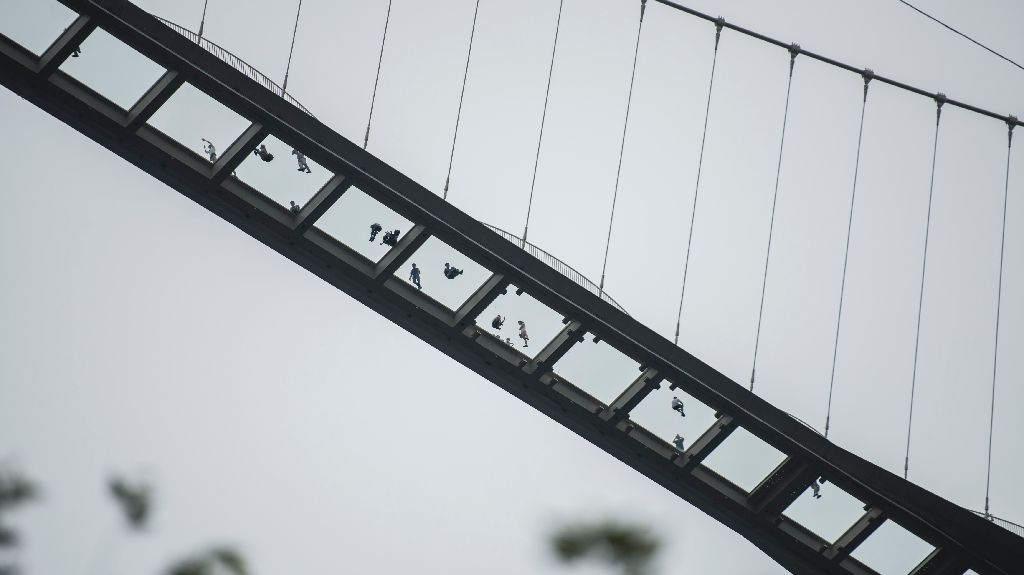
China opens world's longest glass-bottomed bridge

Yahoo – AFP, August 21, 2016

Some 430 metres (1,400 feet) long and suspended 300 metres above the earth,
the bridge spans a canyon between two mountain cliffs in Zhangjiajie park in
China's central Hunan province (AFP Photo/Fred Dufour)

The world's highest and longest glass-bottomed bridge opened in China's spectacular Zhangjiajie mountains -- the inspiration for American blockbuster Avatar.

Some 430 metres (1,400 feet) long and suspended 300 metres above the earth, the bridge spans the canyon between two mountain cliffs in Zhangjiajie park in China's central Hunan province.

Six metres wide and made of some 99 panels of clear glass, the bridge can carry up to 800 people at the same time, an official in Zhangjiajie -- a popular tourist destination -- told the Xinhua news agency.

Tourists can walk across the bridge, designed by Israeli architect Haim Dotan, and the more adventurous will be able to bungee jump or ride a zip line.

"I wanted to feel awe-inspired by this bridge. But I'm not afraid -- it seems safe!" Wang Min, who was visiting the new structure with her husband and children, told AFP Saturday.

Following an alarming glass bridge cracking incident at the Yuntai mountain in northern Henan in 2015, authorities in Zhangjiajie were eager to demonstrate the safety of the structure.

A tourist takes a photograph on the world's highest and longest glass-bottomed bridge 
above a valley in Zhangjiajie in China's Hunan province (AFP Photo/Fred Dufour)

They organised a string of media events, including one where people were encouraged to try and smash the bridge's glass panels with a sledge hammer, and another where they drove a car across it.

"It's crowded today and a bit of a mess. But to be suspended 300 metres in the air, it's a unique experience," said Lin Chenglu, who had come to see the bridge with his colleagues.

Only 8,000 people each day will be allowed to cross the bridge, Xinhua said, and tourists will have to book their tickets a day in advance, at a cost of 138 yuan ($20).

Cameras and selfie sticks are banned, and people wearing stilettos will not be allowed to walk on the bridge, Xinhua said.

Local authorities have said that one of the summits in Zhangjiajie Park inspired the floating mountain which appears in the American blockbuster Avatar.

A Hollywood photographer visited the area in 2008, taking images which were used for the film, according to media reports.


Thursday, September 18, 2014

Urine: a new renewable energy source?

The search for renewable energy has made use of the sun, the sea - and now potentially our wee. Researchers in England have been using urine to create small electrical charges, which could be scaled up to a fuel source.

Deutsche Welle, 17 Sep 2014


At the "wet lab" in the Bristol Robotics laboratory in southwest England, there's a not-so-pleasant smell. It's "similar to the smell of a toilet, of the gents," explained scientist Ioannis Ieropoulos.

Scientists have known for some time that microbes can generate electricity. When microbes break down organic material such as food waste or grass clippings, electrons and protons are freed, which can work to push electronic current around a circuit like a battery.

Ieropoulos had been studying this process for more than a decade to see if it could be used to power robots - but it was only recently that he realized the power of urine.

For eight or nine years, Ieropoulos said, the researchers at the Bristol lab "tried grass clippings - we tried prawn shells, we tried dead insects, we tried rotten fruit, we tried waste water."

The "eureka moment," Ieropoulos said, was when they tried urine. "We'd never before reached that level of power output."

Small system already developed

In fuel cells, chemicals are converted to
electricity - the one pictured here uses
hydrogen and oxygen
Ieropoulos found that by adding fresh urine to his microbes, he could increase the power output three fold.

The doctor created a simple system: a urinal that is linked up via a microbial fuel cell to a USB port, which generates enough electricity to charge small electronic devices like mobile phones.

The invention impressed the Bill and Melinda Gates foundation so much that it gave the lab a grant to improve the technology and get it working in the real world.

Ieropoulos said that they're aiming for large-scale implementation. But he added that their larger goal is to do "something for society."

Systems could be implemented, for example, to help tackle health and sanitation issues, and "deliver useful electricity to remote communities that are not connected to the grid," Ieropoulos said.

Improving sanitation, helping the environment

The Gates Foundation grant enabled Ioannis to travel to Delhi to showcase his invention, which he's named "Urinetricity."

Sarina Prabasi, CEO of Water Aid America, said that Urinetricity could play a vital role in improving sanitation in developing areas. Prabasi thinks that it could provide the incentive communities need to deal with their waste, which is often lacking.

"If there's something where people can turn this in to a business, then the incentive will be there," Prabasi said.

It's hoped that large-scale application
of "Urinetricity" can help grow crops
Combining the fuel cells with water purification technology could also make a difference provide environmental benefits. John Greenman, a professor at the University of the West of England in Bristol, is working with microbes that produce clean water and fertilizer, which can help grow crops.

This could, for example, be combined with Ioannis' system to create a "super toilet."

Unprocessed urine cannot be applied directly to cropland. But microbes separate the organic material out of the waste, Greenman explained. "The fluid that comes off at the other end is a lot cleaner, and can be put out into nature," he said.

"And the electricity generated could be used to run water treatment plants - so you get benefits in both ways," Greenman stated. In a green factory, for example, such a system could break down waste while producing electricity.

Overcoming the taboo

Ieropoulos acknowledged that one of the hurdles for his project is the discomfort some people might have around the source of the new electricity.

"There are taboos, cultural and religious issues that prevent people from talking about the topic of human waste and how that can be exploited or utilized," Ieropoulos said.

Although many people might struggle to keep a straight face about the topic, the benefits to for people and the environment will hopefully outweigh squeamishness around using urine for electricity.

Related Articles:


Ready for use: lawn fertiliser made from city officials' urine

Thursday, December 10, 2009

Govt to kick off reconstruction in W. Sumatera this month

Syofiardi B. Jb, The Jakarta Post, Padang | Thu, 12/10/2009 3:21 PM


The government is set to rebuild and repair houses in six districts that were badly damaged during a powerful earthquake in West Sumatera in September.


The six worst-hit districts are Patamuan of Padangpariaman regency, Koto Tengah of Padang city, North Pariaman of Pariaman city, Bayang of Pesisirselatan regency and Luhak Nan Duo of Pasamanbarat.


Febrin Anas Ismail, head of the provincial's assesment team for buildings, said on Wednesday the government would begin the reconstruction program this month and would continue until 2012.


“We will receive around Rp 115 billion (US$ 12 million) for the program in six districts which is still being processed by the National Disaster Mitigation Agency (BNPB),” Febrin said.


The government plans to give Rp 15 million to each resident whose house suffered major damage, Rp 10 million for every owner whose home is experiencing moderate devastation and Rp 1 million for each home with minor ruins. There are a total of 114,797 homes with major damages, 67,198 with moderate devastation and 67,838 with minor ruins.


“We actually need a total of Rp 3. 7 trillion for the whole recontruction program for all areas across the province. But due to limited budget, we will focus on the six districts this year,” Febrin told The Jakarta Post.


He added that the government would hand over the cash to some people who were chairing the groups formed by between 20 and 25 house owners.


More than 1,000 people were killed when the 7.9 earthquake jolted the province in late September.


Thursday, November 19, 2009

PLN to fine contractors delaying projects

Antara News, Thursday, November 19, 2009 17:24 WIB


Jakarta (ANTARA News) - State-owned electricity company PLN will fine contractors delaying the completion of their projects under the 10,000 megawatt (MW) power plant projects, a PLN director said.


PLN`s director for strategic construction affairs Agung Nugroho said here on Thursday that the fine would be imposed on contractors who could not show acceptable reasons of the delay.


"The fine has been stipulated in the contracts," he said.


He said that the fine amounts up to five percent of the total contract value, which comes to one per mill per day.


In the meantime, contractors could also lodge a complaint if PLN delayed payments.


PLN estimated that only about 915 MW of the projected 1,890 MW under the 10,000 MW mega project crash program would be completed at the end of this year.


Sunday, March 15, 2009

Jakarta needs planning supervision: Experts

The Jakarta Post, JAKARTA | Sat, 03/14/2009 1:53 PM

Corruption and a lack of professionalism among government officials and contractors has contributed to many building failures across Jakarta, a seminar concluded on Friday.

Sulistijo Sidarto Mulyo, chairman of Association of Southeast Asian Nations’ (ASEAN) charter of professional engineers, said “building failures” did not just mean building collapsing, but also included poorly planned buildings.

“New schools with no students, or overpriced construction costs for a seaport are also examples of building failures,” Sulistijo told a seminar held by Pelita Harapan University.

If the government and developers worked by the book, these failures could be avoided, he said.

In South Korea, for example, developers must show would-be buyers all materials they intend to use for an apartment, Sulistijo said.

“They [the developers] would not dare change the quality of the materials. Here, developers show materials in promotional brochures but then use lower quality materials in construction,” he lamented.

Sulistijo told a story about an earthquake in a country not unlike Indonesia, in 1985.

“All government buildings crumbled, and only a few were left intact. This showed that not only had substandard materials been used, but that corruption was also invovled,” he said.

A similar catastrophe could happen in Jakarta, Sulistijo said.

Another speaker, Manlian Ronald Simanjuntak of the UPH civil engineering faculty, said building conversions were often a sign of building failure too.

“Basically, if we don’t feel comfortable with a building, this is a sign of a building’s failure,” Manlian said.

He highlighted the conversion of residential areas in the city into commercial premises as a good example of building failure.

As the economy expands and spaces are increasingly hard to find, many Jakarta residents have converted their houses into commercial properties.

South Jakarta municipality reported that owners of 1,649 buildings were abusing their residential permits. Many of these were being used as beauty clinics, spas, cafes, restaurants, offices, storage facilities and pharmacies.

“This is a case of building failure, but the administration doesn’t dare recognize it as a failure because they were the ones who handed out the permits.”

Sulistijo said that good buildings were ones that provided the most benefit to an area, over a certain time frame.

“We are really weak in the area of supervision of building developments,” he said.

He admitted that an independent body, like MUPA (Manggala Utama Penilai Ahli) whose engineering experts members, had yet to take on a supervisory role in building planning and development in Jakarta. (iwp)

Tuesday, March 10, 2009

LPKJN to Train Unemployed

Tuesday, 10 March, 2009 | 13:20 WIB 


TEMPO Interactive, Jakarta: The National Construction Services Development Institute (LPJKN) will train unemployed people from non-construction sectors for infrastructure projects. 


LPJKN head Malkan Amin said the training sessions will be held for two weeks each. 


However, the recruitment mechanism for the sessions is not yet clear. 


Malkan explained that there already was an agreement between LPJKN and the Public Works Department as well as the Manpower and Transmigration Department for this. 


He went on to say that infrastructure projects could provide many job opportunities. 


LPJKN is being asked to publicize the information and coordinate the training. 


However, Malkan acknowledged that participants joining the training sessions will not have any income for two weeks and this could be a problem. 


“We will pay for the training expenses, but who will bear their family costs for two weeks?” he asked. 


Sumaryanto Widayatin, Head of the Construction and Human Resources Empowerment Board at the Public Works Department, has agreed with the idea of providing training. 


He said that the construction sector provided the most job opportunities. 


“To survive the crisis, we should prioritize this sector,” he said Sumaryanto. 


DIAN YULIASTUTI 


Thursday, February 12, 2009

Bekasi, Tangerang get ‘rusunami’

The Jakarta Post, BEKASI, TANGERANG | Thu, 02/12/2009 12:00 PM  


State-owned housing company Perumnas has started building four towers of subsidized, low-cost apartments (rusunami) in Bekasi, the company’s director said Wednesday. 


Center Point Apartment will occupy 1.4 hectares of land near the Jakarta-Cikampek tollgate, said Perumnas marketing director Tedy Robinson.


“We expect to complete construction of the first tower by the end of this year,” Tedy said, as quoted by Antara news agency. 


Each of the four towers will comprise 16 levels with 870 units of type-22 and type-36 apartments, which will be sold at Rp 88 million and Rp 144 million, respectively. 


Even though the apartments will be sold at low prices, he said, Perumnas would provide facilities similar to high-class apartments.


“We will build a swimming pool, hospital, shopping center and playgrounds, as well as a café and restaurant in the area.”     


He said the strategic location of Center Point Apartment had attracted many customers, with 80 percent of the units to be constructed in phase one already sold.


The apartments are located across from Bekasi Mitra Keluarga Hospital and next to the Islamic Center building and Pondok Gede boarding house for pilgrims, he said.


Tedy said the Bekasi administration supported the construction by issuing a building permit.


A Tangerang official said the administration supported the government’s program to build subsidized, low-cost apartments by building two towers in the region.


The construction of the two towers, located in Cireundeu Ciputat Timur in South Tangerang, is pressing ahead, said Muhammad Hidayat, the head of the Integrated Agency of Service and Licensing (BP2T).  


Hidayat said the Tangerang administration issued a permit on the construction and another permit on spatial planning for the two towers.


“In building the apartments, we have complied with the regulation on water reservoir areas,” he said.    


He said that the construction was responsible so long as it complied with of the analysis of environmental impact (Amdal).


The development of low-cost apartments in Bekasi and Tangerang are part of the central government’s plan to construct 1,000 towers, or 600,000 units, of subsidized apartments nationwide within the next four to five years.


The apartments are sold at a maximum price of Rp 144 million per unit to people earning less than Rp 4.5 million per month.


Half of the towers will be built in Greater Jakarta, 30 percent in cities throughout Java and the remaining 20 percent in urban areas outside Java.


The Public Housing Ministry has estimated that Jakarta will be home to around 51,000 subsidized apartment units by the end of this year.


To encourage more developers to take part in the projects, the government has offered incentives such as tax breaks and subsidies.


Tuesday, January 20, 2009

Condos Canceled As Demand Dries Up

The Jakarta Globe, Dian Ariffahmi, January 20, 2009


Indonesia is facing a gloomy outlook in its condominium business as some property companies defer their apartment projects and return their customers’ money as demand slows, a property analyst said on Monday.


“The tight monetary policy [high interest rates and tighter loan approvals] has impacted on project cash flow and turned off prospective buyers,” Utami Prastiana, a property analyst from Procon Indah, said in Jakarta, adding that further delays were likely to affect the sector until mid-2009.


One Park Residences, which has been developed in Kebayoran Baru by PT Gandaria Permai, a subsidiary company of PT Intiland Development Tbk, has delayed its condominium project and is going to return condo buyers’ money with interest soon, he said.


Utami said there were two other developers which had also canceled their projects because of the crisis, but refused to name them.


The Rp 300 billion ($27 million) residence projects, which was previously planned to be launched in the fourth quarter last year, was canceled due to the increasing price of project materials and a lack of demand from buyers, he said.


“In the fourth quarter last year the country’s rate for the amount of presold condominiums declined only slightly from 0.4 percent from its previous quarter of 95.6 percent to 95.2 percent,” Utami said.


The declining rate, she said, would continue into the first quarter this year, and likely to balloon to between 3 to 10 percent.


“Condo buyers are in a wait-and-see mode and prefer to keep their plans on hold until the interest rate goes back to normal or at least decreases from the current rate,” Utami said.


Procon’s 2008 report stated that 8,000 new condominiums were sold in Jakarta in 2008 from a supply of 8,400. The number sharply declined from the previous year’s report which saw around 12,000 units produced and sold in the same year.


In 2009, projected annual net supply of around 10,000 units will have a net take up of only 6,600. About 6,100 of those units are in mostly in less preferable locations such as on the borders of Jakarta, Utami said.


“Developers and buyers will be more rational in their investment decisions, therefore a few projects may not be completed on time,” he said.


Tuesday, December 30, 2008

State infrastructure projects to boost WIKA's earnings next year

Alfian, The Jakarta Post, Jakarta | Tue, 12/30/2008 11:02 AM  


State-owned construction firm PT Wijaya Karya (WIKA) expects a 15.63 percent jump in revenue in 2009 after a pledge by the government to spend huge state funds next year on infrastructure projects. 


In a statement Sunday, WIKA forecast its 2009 revenue would rise to Rp 7.4 trillion (US$669 million) from about Rp 6.4 trillion this year, while net profit for 2009 is forecast to rise to Rp 175 billion, up by 21.5 percent on the Rp 144 billion forecast for the end of 2008. 


WIKA finance director Ganda Kusuma said the company was fully aware of the unfavorable conditions for next year's business, but remained optimistic it would enjoy substantial growth due to government-sponsored infrastructure projects. 


"The company will focus on government projects (next year) both from the central and regional governments. We will also focus our efforts on securing our liquidity," Ganda said. 


As of November this year, WIKA had secured multi-annual contracts valued at a total of Rp 14.31 trillion. 


The company expects to win five more construction projects with a total value of Rp 883.25 billion by the end of December. 


These projects include part of the work on a 700 megawatt power plant in Tanjung Priok, North Jakarta including a contract worth Rp 340 billion; a high school building worth Rp 65.89 billion and a sports center worth Rp 118.59 billion in Kuantan Sengingi, Riau Province. 


Other projects include a dam in Tembesi, Riau Islands Province valued at Rp 224.05 billion and a flood canal project for the Ciliwung and Cisadane rivers in West Java worth Rp 883.25 billion. 


WIKA said it would get more revenue next year because of several ongoing power plant projects which were multi-annual projects scheduled to be completed in 2010. 


The power plant projects and other infrastructure projects would contribute substantially to the company's revenue this year and in the next few years. 


The government has allocated a budget of Rp 34.98 trillion for the public works ministry next year. 


WIKA is also looking at projects from state companies, especially from state power company PT Perusahaan Listrik Negara (PLN) which is in the process of completing the construction of a power plant program totaling 10,000 megawatts of electrical capacity under the government's accelerated power


Saturday, December 13, 2008

University of Indonesia receives international accreditation

The Jakarta Post, Jakarta | Sat, 12/13/2008 3:24 PM  


The Civil and Engineering Department of University of Indonesia (UI) received international accreditation on Friday, after being evaluated by the AUN-QA International Accreditation panel. 


"This is a huge success for Indonesia," UI Rector Gumilar Rusliwa Soemantri said, as quoted by tempointeraktif.com on Saturday. 


Deputy Executive Director of ASEAN University Network Nantana Gajaseni announced the conferral on Friday, stating that the faculty had met various standards, including learning outcomes, learning strategy, and quality assurance and learning facilities. 


"This will make international credit transfers, research collaboration and journal writing easier to accomplish," Soemantri said. 


"The nation's awakening can only be achieved through a cultural revolution that increases the quality of human resources, and the key to that is responsible formal education," he added.


Friday, December 12, 2008

Police to question seven workers over Mulyorejo bridge collapse

The Jakarta Post, Jakarta | Fri, 12/12/2008 5:05 PM 


The Police are questioning six workers and a deputy project coordinator responsible for constructing a bridge that had collapsed in Mulyorejo, Surabaya.


East Surabaya Police Resort Chief Aj. Comm. Eko Iswantono told tempointeraktif.com on Friday that the investigation was aimed at solving the causes for the collapse of the joint-PT Waskita Karya and PT Cipta Karya-constructed bridge that had claimed three lives.


"We begun our investigation from the bottom up. We will question everyone involved in the construction of the bridge," Iswantono said, as quoted by tempointeraktif.com.


Three workers from Bangkalan, Ahmad, Hadiri and Idris all drowned in the river right under the bridge when it collapsed.


Only the remains of Idris had been found.


Monday, November 24, 2008

Indonesia vying for construction market in Dubai

Jakarta (ANTARA News) - Public Works Minister Djoko Kirmanto and a number of construction businessmen will be visiting Dubai in an effort to win a number of construction projects in the Middle East country, a Public Works Ministry Spokesman said. 


"We will try our best to construction market in the Middle East though Dubai because Dubai is the biggest financial center in the Middle East like Singapore in Asia," Sumaryanto Widayatin, head of construction development affairs of the Ministry of Public Works, said here on Monday. 


The minister`s delegation will be visiting Dubai during which it would attend an expo held in that country. 


Widayatin, who is one of the 40 members of the Indonesian delegation, said that the Indonesian construction businesses were to take part in the expo in order to seize construction business opportunities. 


He said that the construction market in Dubai was estimated at US$20 billion. It needed skills such as in the building maintenance. 


Widayatin said that Dubai itself was known as the `big five` in the building business in the Middle East that would surely promise a good market potential. 


He said that Indonesia was now preparing to set up a representative office i Dubai. "The problem is whether to open our own branch office or just to join with the Indonesian Embassy`s attache," he added. 


Widayatin said that could not set any business target for Indonesia in the expo which would be held for three days. 


The public works ministry official said that Dubai had relative big market potentials but it was hard for Indonesian contractors to take part not because of competition but because of certainties in the payments. 


"Overseas, we don`t know to whom the payments that are obtained should be charged. There must be certainties with regard to this. After all, we also need certainties in banking support because no supporting banks already available overseas," he added. 


He said that at present Dubai still had plans to build a lot of new buildings most of which were high rise ones.


Wednesday, November 19, 2008

WIKA to acquire Citra Insan Pertiwi

The Jakarta Post, Wed, 11/19/2008 10:48 AM  


JAKARTA: State owned construction firm PT Wijaya Karya (WIKA) will spend at least Rp 23 billion (US$1.94 million) to acquire a majority stake in PT Catur Insan Pertiwi (CIP), a mechanical and electrical construction company. 


In a statement on Tuesday, WIKA announced it had acquired 70.08 percent of CIP's shares in a bid to support WIKA's power plants construction projects. 


"We are optimistic that this effort will boost WIKA competitiveness in building power plants. This will support WIKA's margin growth in the future," WIKA's president director Bintang Perbowo said in the statement. 


CIP is a private domestic company focusing on mechanical and electrical construction for power plants projects. By buying the company, WIKA expects to increase its cost efficiency and operational effectiveness. 


WIKA recently won several power plants projects, including Muara Karang power plant in Jakarta; Indramayu and Pelabuhan Ratu power plants in West Java, Labuan Banten power plant in Banten, and several other power plants in Sumatera, Sulawesi and Kalimantan.


Saturday, November 8, 2008

Glass maker Asahimas boost from building industry

The Jakarta Post, Jakarta | Sat, 11/08/2008 11:50 AM


Publicly listed PT Asahimas Flat Glass, Southeast Asia's largest glass producer, recorded a hefty profit during the first nine months of the year on higher demand from the construction sector.


The subsidiary of Japan's Asahi Glass Co. Ltd. booked Rp 205 billion (US$18.5 million) in net profit, up by 111 percent from Rp 97 billion posted in the same period of last year, according to the company's director, Samuel Rumbajan on Friday.


"The 10 to 15 percent growth in the construction sector this year has boosted our sales during the last nine months," he said.


Samuel said the company's strategy to increase its product prices by an average of five percent had also helped boost sales, which soared to Rp 1.71 trillion from Rp 1.34 trillion.


More than 70 percent of the company's production is flat glass for construction purposes while the remaining 30 percent is for the automotive industry.


In response to anticipated lower demand next year due to global recession, Samuel remained upbeat that the company's growth would remain steady.


"As the world's industry growth is declining, we can't predict our growth next year, or even until the end of the year," he said.


The company distributes its product mainly to Asian countries, Australia and New Zealand.


Asahimas is now operating three factories in Jakarta, Cikampek and Sidoarjo, East Java, with a total annual production capacity of 570,000 tons of flat glass, 4.5 million square meters of safety glass and 2.4 million square meters of mirror.


The company is 43.86 percent owned by Asahi Glass and 40.67 percent by PT Rodamas, according to the Indonesia Stock Exchange. (hwa)